2013年8月12日 星期一

聖山教育展版線上導覽-228台灣神的信仰:為何祂們代表台灣神


點擊上圖可看大圖
/ 台灣大地文教基金會
2013-08-06

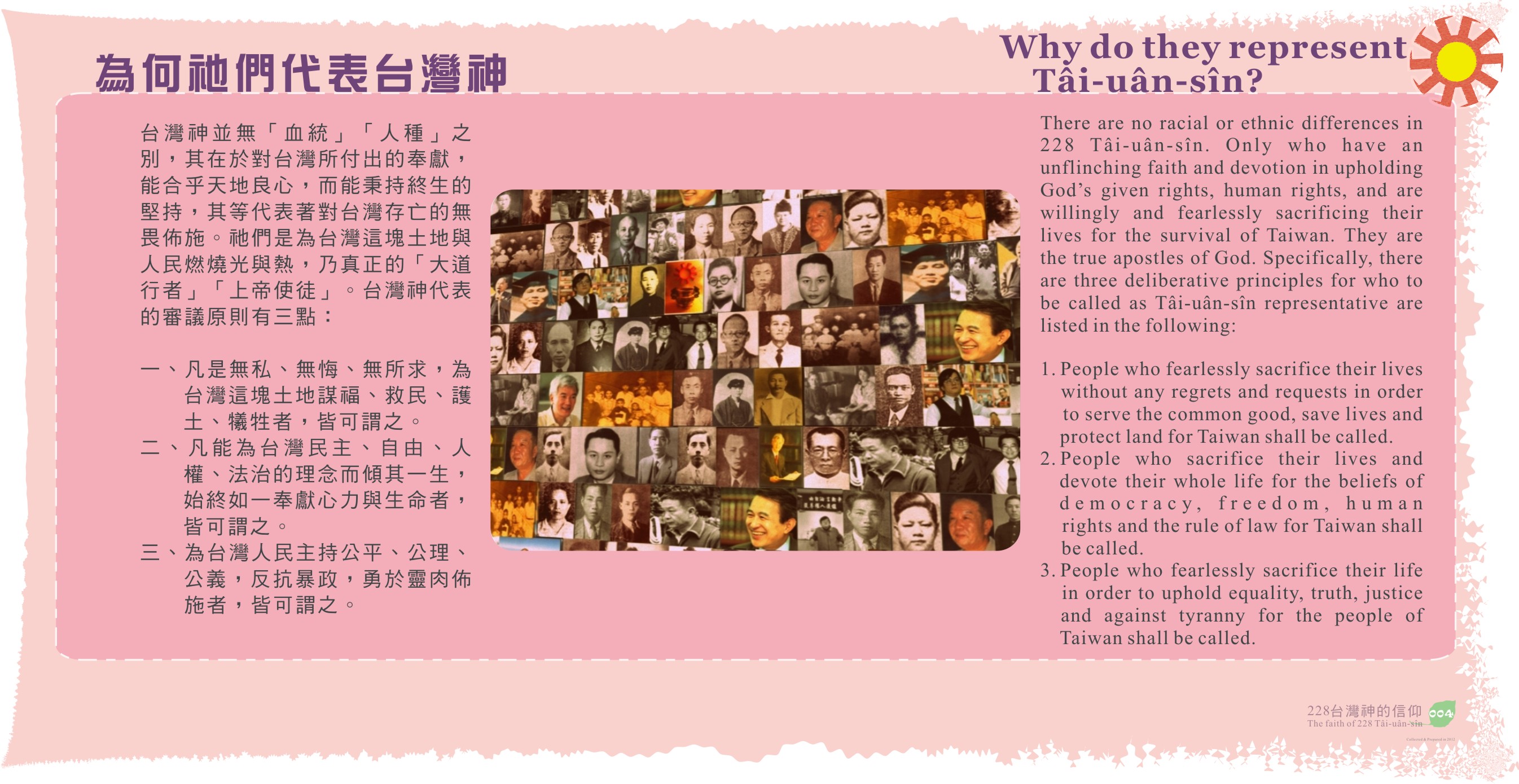
為何祂們代表台灣神
台灣神並無「血統」「人種」之別,其在於對台灣所付出的奉獻,能合乎天地良心,而能秉持終生的堅持,其等代表著對台灣存亡的無畏佈施。祂們是為台灣這塊土地與人民燃燒光與熱,乃真正的「大道行者」「上帝使徒」。台灣神代表的審議原則有三點:

一、凡是無私、無悔、無所求,為台灣這塊土地謀福、救民、護土、犧牲者,皆可謂之。
二、凡能為台灣民主、自由、人權、法治的理念而傾其一生,始終如一奉獻心力與生命者,皆可謂之。
三、為台灣人民主持公平、公理、公義,反抗暴政,勇於靈肉佈施者,皆可謂之。
(未完待續)
Why do they represent Tâi-uân-sîn? 
There are no racial or ethnic differences in 228 Tâi-uân-sîn. Only who have an unflinching faith and devotion in upholding God’s given rights, human rights, and are willingly and fearlessly sacrificing their lives for the survival of Taiwan. They are the true apostles of God. Specifically, there are three deliberative principles for who to be called as Tâi-uân-sîn representative are listed in the following:

1.People who fearlessly sacrifice their lives without any regrets and requests in order to serve the common good, save lives and protect land for Taiwan shall be called.
2.People who sacrifice their lives and devote their whole life for the beliefs of    democracy, freedom, human rights and the rule of law for Taiwan shall be called.
3.People who fearlessly sacrifice their life in order to uphold equality, truth, justice   and against tyranny for the people of Taiwan shall be called.
(to be continued)

聖山教育展版線上導覽-228台灣神的信仰:為何稱為「228台灣神」(2/2)


點擊上圖可看大圖
/ 台灣大地文教基金會
2013-08-05

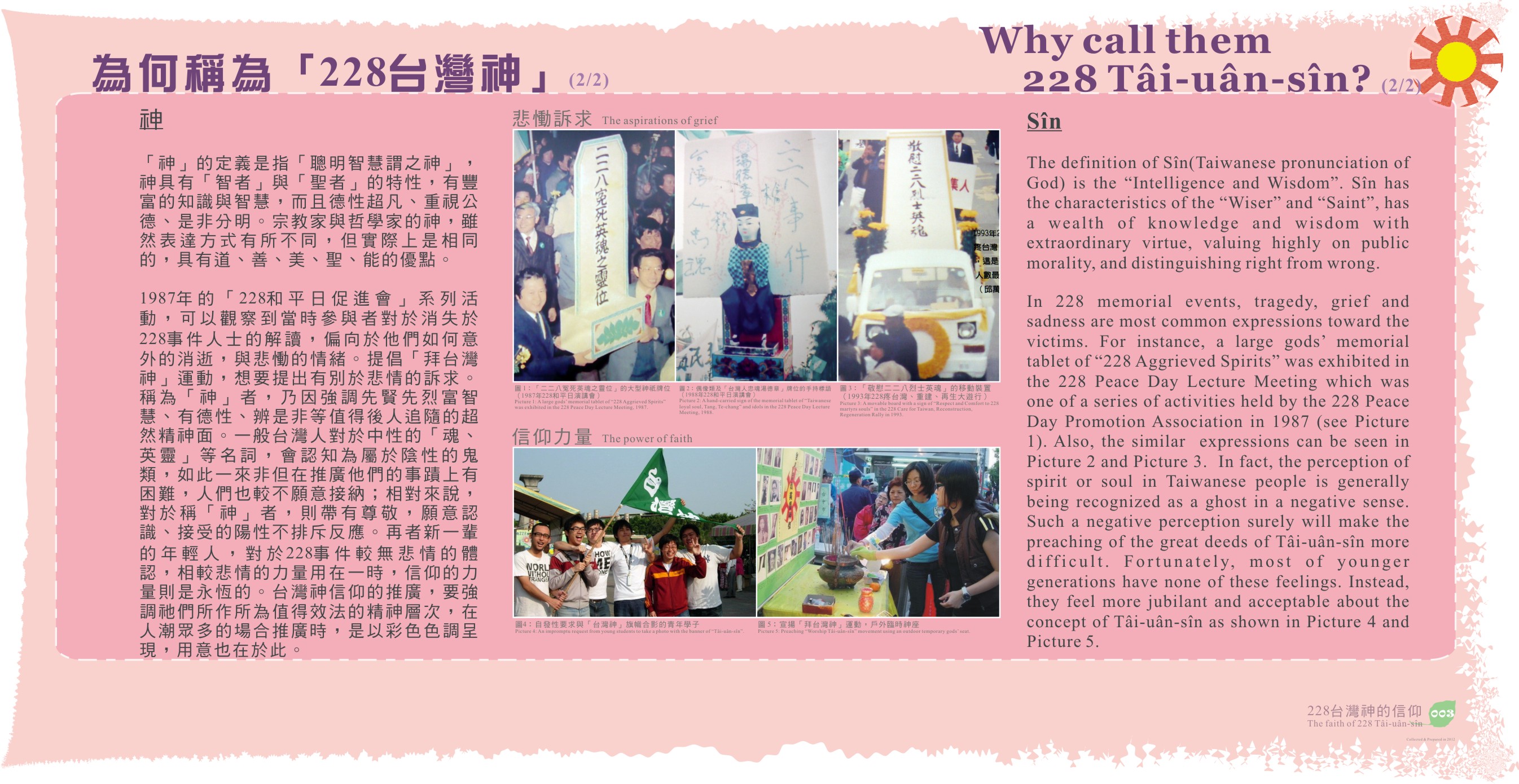
為何稱為「228台灣神」(2/2)
神
「神」的定義是指「聰明智慧謂之神」,神具有「智者」與「聖者」的特性,有豐富的知識與智慧,而且德性超凡、重視公德、是非分明。宗教家與哲學家的神,雖然表達方式有所不同,但實際上是相同的,具有道、善、美、聖、能的優點。

1987年的「228和平日促進會」系列活動,可以觀察到當時參與者對於消失於228事件人士的解讀,偏向於他們如何意外的消逝,與悲慟的情緒。提倡「拜台灣神」運動,想要提出有別於悲情的訴求。稱為「神」者,乃因強調先賢先烈富智慧、有德性、辨是非等值得後人追隨的超然精神面。一般台灣人對於中性的「魂、英靈」等名詞,會認知為屬於陰性的鬼類,如此一來非但在推廣他們的事蹟上有困難,人們也較不願意接納;相對來說,對於稱「神」者,則帶有尊敬,願意認識、接受的陽性不排斥反應。再者新一輩的年輕人,對於228事件較無悲情的體認,相較悲情的力量用在一時,信仰的力量則是永恆的。台灣神信仰的推廣,要強調祂們所作所為值得效法的精神層次,在人潮眾多的場合推廣時,是以彩色色調呈現,用意也在於此。

(未完待續)
Why call them 228 Tâi-uân-sîn? (2/2)
Sîn
The definition of Sîn(Taiwanese pronunciation of God) is the “Intelligence and Wisdom”. Sîn has the characteristics of the “Wiser” and “Saint”, has a wealth of knowledge and wisdom with extraordinary virtue, valuing highly on public morality, and distinguishing right from wrong.

In 228 memorial events, tragedy, grief and sadness are most common expressions toward the victims. For instance, a large gods’ memorial tablet of “228 Aggrieved Spirits” was exhibited in the 228 Peace Day Lecture Meeting which was one of a series of activities held by the 228 Peace Day Promotion Association in 1987 (see Picture 1). Also, the similar  expressions can be seen in Picture 2 and Picture 3.  In fact, the perception of spirit or soul in Taiwanese people is generally being recognized as a ghost in a negative sense. Such a negative perception surely will make the preaching of the great deeds of Tâi-uân-sîn more difficult. Fortunately, most of younger generations have none of these feelings. Instead, they feel more jubilant and acceptable about the concept of Tâi-uân-sîn as shown in Picture 4 and Picture 5.

(to be continued)

聖山教育展版線上導覽-228台灣神的信仰:為何稱為「228台灣神」(1/2)


點擊上圖可看大圖
/  台灣大地文教基金會
2013-08-02

為何稱為「228台灣神」(1/2)
228
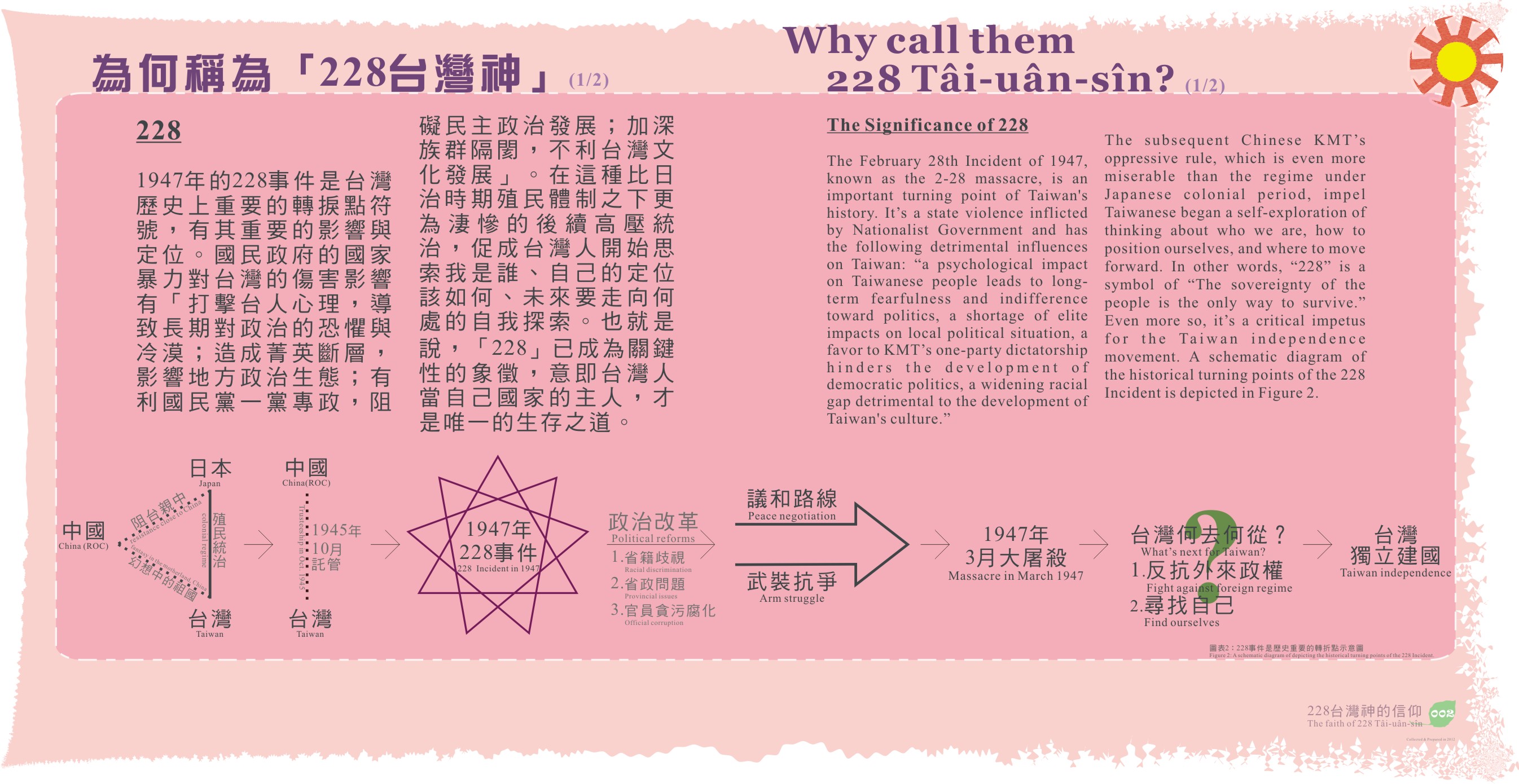
1947年的228事件是台灣歷史上重要的轉捩點符號,有其重要的影響與定位。國民政府的國家暴力對台灣的傷害影響有「打擊台人心理,導致長期對政治的恐懼與冷漠;造成菁英斷層,影響地方政治生態;有利國民黨一黨專政,阻礙民主政治發展;加深族群隔閡,不利台灣文化發展」。在這種比日治時期殖民體制之下更為淒慘的後續高壓統治,促成台灣人開始思索我是誰、自己的定位該如何、未來要走向何處的自我探索。也就是說,「228」已成為關鍵性的象徵,意即台灣人當自己國家的主人,才是唯一的生存之道。
(未完待續)

Why call them 228 Tâi-uân-sîn? (1/2)
The Significance of 228
The February 28th Incident of 1947, known as the 2-28 massacre, is an important turning point of Taiwan's history. It’s a state violence inflicted by Nationalist Government and has the following detrimental influences on Taiwan: “a psychological impact on Taiwanese people leads to long-term fearfulness and indifference toward politics, a shortage of elite impacts on local political situation, a favor to KMT’s one-party dictatorship hinders the development of democratic politics, a widening racial gap detrimental to the development of Taiwan's culture.”

The subsequent Chinese KMT’s oppressive rule, which is even more miserable than the regime under Japanese colonial period, impel Taiwanese began a self-exploration of thinking about who we are, how to position ourselves, and where to move forward. In other words, “228” is a symbol of “The sovereignty of the people is the only way to survive.” Even more so, it’s a critical impetus for the Taiwan independence movement. A schematic diagram of the historical turning points of the 228 Incident is depicted in Figure 2.
(to be continued)

聖山教育展版線上導覽-228台灣神的信仰:發展的背景源由


點擊上圖可看大圖
/ 台灣大地文教基金會
2013-08-01

發展的背景源由
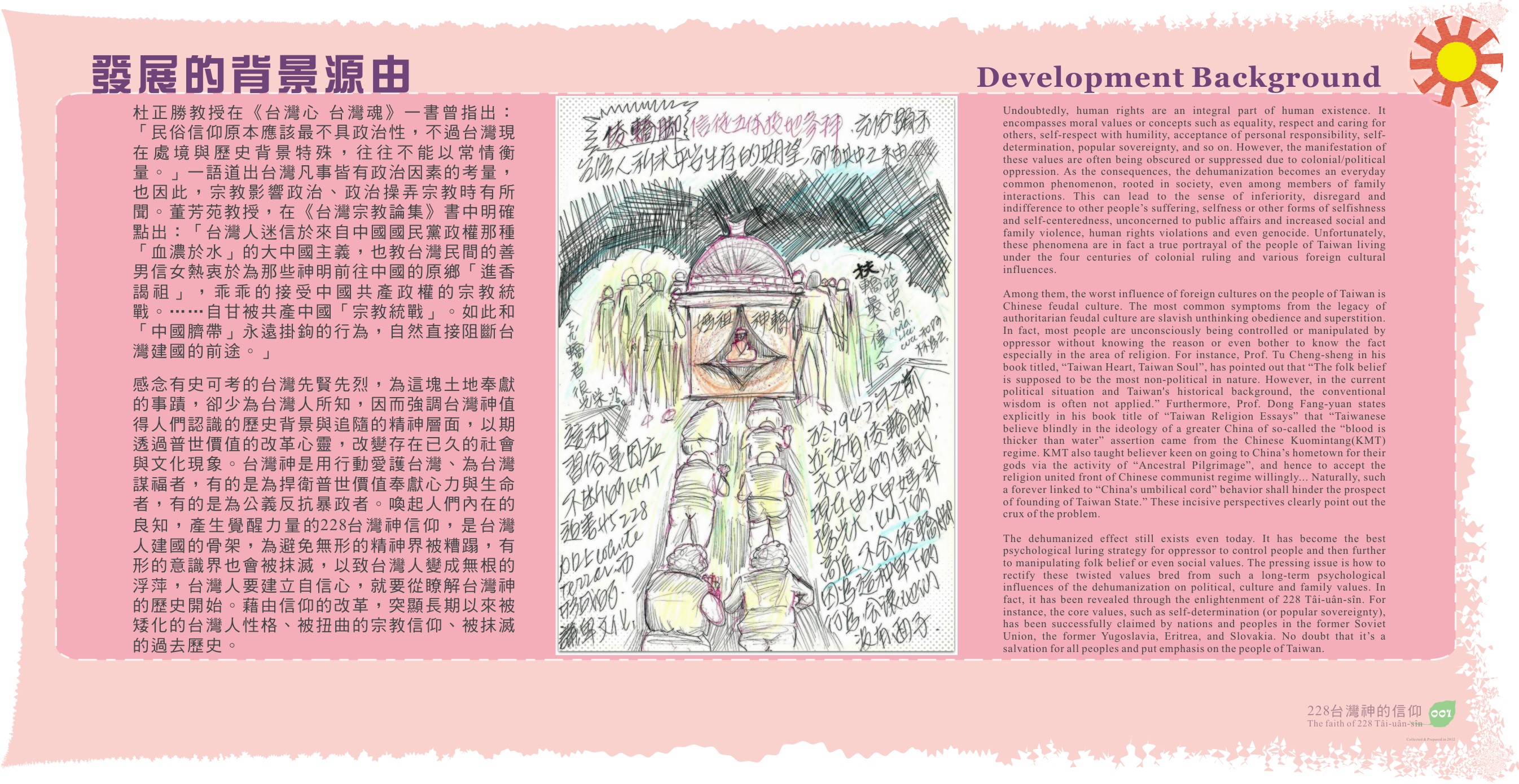
杜正勝教授在《台灣心 台灣魂》一書曾指出:「民俗信仰原本應該最不具政治性,不過台灣現在處境與歷史背景特殊,往往不能以常情衡量。」一語道出台灣凡事皆有政治因素的考量,也因此,宗教影響政治、政治操弄宗教時有所聞。董芳苑教授,在《台灣宗教論集》書中明確點出:「台灣人迷信於來自中國國民黨政權那種「血濃於水」的大中國主義,也教台灣民間的善男信女熱衷於為那些神明前往中國的原鄉「進香謁祖」,乖乖的接受中國共產政權的宗教統戰。……自甘被共產中國「宗教統戰」。如此和「中國臍帶」永遠掛鉤的行為,自然直接阻斷台灣建國的前途。」

感念有史可考的台灣先賢先烈,為這塊土地奉獻的事蹟,卻少為台灣人所知,因而強調台灣神值得人們認識的歷史背景與追隨的精神層面,以期透過普世價值的改革心靈,改變存在已久的社會與文化現象。台灣神是用行動愛護台灣、為台灣謀福者,有的是為捍衛普世價值奉獻心力與生命者,有的是為公義反抗暴政者。喚起人們內在的良知,產生覺醒力量的228台灣神信仰,是台灣人建國的骨架,為避免無形的精神界被糟蹋,有形的意識界也會被抹滅,以致台灣人變成無根的浮萍,台灣人要建立自信心,就要從瞭解台灣神的歷史開始。藉由信仰的改革,突顯長期以來被矮化的台灣人性格、被扭曲的宗教信仰、被抹滅的過去歷史。
(未完待續)

Development Background
Undoubtedly, human rights are an integral part of human existence. It encompasses moral values or concepts such as equality, respect and caring for others, self-respect with humility, acceptance of personal responsibility, self-determination, popular sovereignty, and so on. However, the manifestation of these values are often being obscured or suppressed due to colonial/political oppression. As the consequences, the dehumanization becomes an everyday common phenomenon, rooted in society, even among members of family interactions. This can lead to the sense of inferiority, disregard and indifference to other people’s suffering, selfness or other forms of selfishness and self-centeredness, unconcerned to public affairs and increased social and family violence, human rights violations and even genocide. Unfortunately, these phenomena are in fact a true portrayal of the people of Taiwan living under the four centuries of colonial ruling and various foreign cultural influences.

Among them, the worst influence of foreign cultures on the people of Taiwan is Chinese feudal culture. The most common symptoms from the legacy of authoritarian feudal culture are slavish unthinking obedience and superstition. In fact, most people are unconsciously being controlled or manipulated by oppressor without knowing the reason or even bother to know the fact especially in the area of religion. For instance, Prof. Tu Cheng-sheng in his book titled, “Taiwan Heart, Taiwan Soul”, has pointed out that “The folk belief is supposed to be the most non-political in nature. However, in the current political situation and Taiwan's historical background, the conventional wisdom is often not applied.” Furthermore, Prof. Dong Fang-yuan states explicitly in his book title of “Taiwan Religion Essays” that “Taiwanese believe blindly in the ideology of a greater China of so-called the “blood is thicker than water” assertion came from the Chinese Kuomintang(KMT) regime. KMT also taught believer keen on going to China’s hometown for their gods via the activity of “Ancestral Pilgrimage”, and hence to accept the religion united front of Chinese communist regime willingly... Naturally, such a forever linked to “China's umbilical cord” behavior shall hinder the prospect of founding of Taiwan State.” These incisive perspectives clearly point out the crux of the problem.

The dehumanized effect still exists even today. It has become the best psychological luring strategy for oppressor to control people and then further to manipulating folk belief or even social values. The pressing issue is how to rectify these twisted values bred from such a long-term psychological influences of the dehumanization on political, culture and family values. In fact, it has been revealed through the enlightenment of 228 Tâi-uân-sîn. For instance, the core values, such as self-determination (or popular sovereignty), has been successfully claimed by nations and peoples in the former Soviet Union, the former Yugoslavia, Eritrea, and Slovakia. No doubt that it’s a salvation for all peoples and put emphasis on the people of Taiwan.
(to be continued)

聖山教育展版線上導覽-受難者故事(9)胡鑫麟、劉明、施儒珍


/  台灣大地文教基金會
2013-08-04

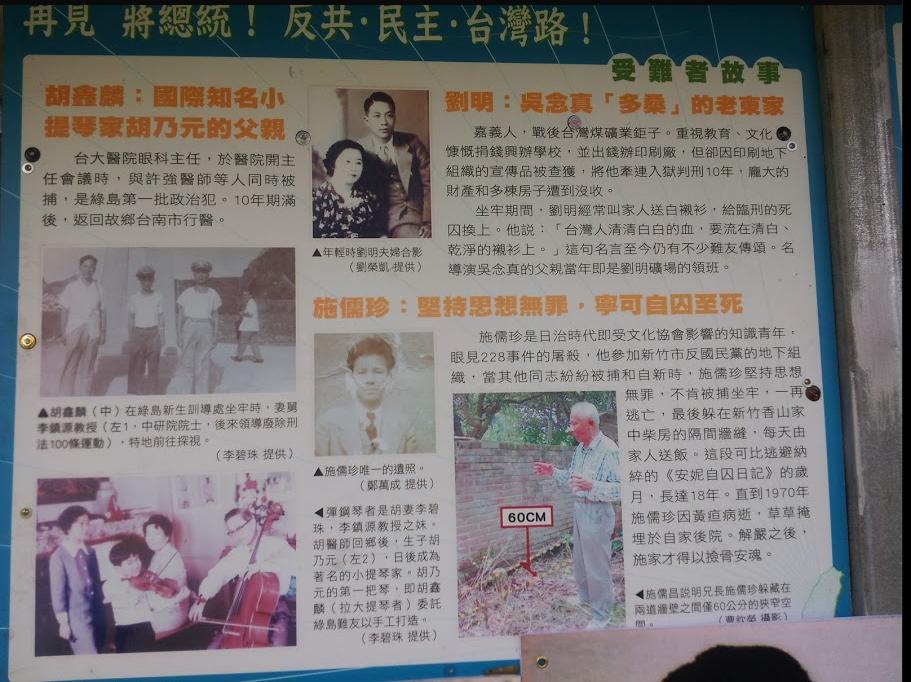
胡鑫麟:國際知名小提琴家胡乃元的父親台大醫院眼科主任,於醫院開主任會議時,與許強醫師等人同時被捕,是綠島第一批政治犯。10年期滿後,返回故鄉台南市行醫。

劉明:吳念真「多桑」的老東家
嘉義人,戰後台灣煤礦業鉅子。重視教育、文化,慷慨捐錢興辦學校,並出錢辦印刷廠,但卻因印刷地下組織的宣傳品被查獲,將他牽連入獄判刑10年,龐大的財產和多棟房子遭到沒收。

坐牢期間,劉明經常叫家人送白襯衫,給臨刑的死囚換上。他說:「台灣人清清白白的血,要流在清白、乾淨的襯衫上。」這句名言至今仍有不少難友傳頌。名導演吳念真的父親當年即是劉明礦場的領班。

施儒珍:堅持思想無罪,寧可自囚至死
施儒珍是日治時代即受文化協會影響的知識青年,眼見228事件的屠殺,他參加新竹市反國民黨的地下組織,當其他同志紛紛被捕和自新時,施儒珍堅持思想無罪,不肯被捕坐牢,一再逃亡,最後躲在新竹香山家中柴房的隔間牆縫,每天由家人送飯。這段可比逃避納綷的《安妮自囚日記》的歲月,長達18年。直到1970年施儒珍因黃疸病逝,草草掩埋於自家後院。解嚴之後,施家才得以撿骨安魂。

聖山教育展版線上導覽-228台灣神的信仰


點擊上圖可看大圖
/ 台灣大地文教基金會
2013-07-31

228台灣神的信仰
228台灣神信仰的獨特性,除了以台灣主體性為出發點,更重要的是透過一般台灣人可接受的普遍化、世俗化方式,推廣台灣神用生命寫歷史的所作所為與追隨其精神面。台灣因特殊的歷史背景與處境,顯而易見中國宗教統戰的痕跡,台灣人要避免成為無根的浮萍,就要從紮根的本土信仰開始。

在此呈現台灣神信仰擬似宗教、社會運動的文化現象,發展的形塑過程等階段性歷程。台灣當前面臨的最大困境,就是自由、民主、人權、法治的消逝,和台灣主體性的流失,以及中國文化與宗教入侵的威脅。這些展板主要的呈現目的,就是用以喚醒人們對於這些危機的警覺,並捍衛這些普世價值,以堅定不移的決心來增強追求台灣獨立的意志。
(未完待續)

The faith of 228 Tâi-uân-sîn
228 Tâi-uân-sîn(Taiwanese pronunciation of Taiwan gods) is a primordial faith beyond ethnic, political and religious boundaries, with freedom, democracy, human rights and rule of law as the core values, to put focus on Taiwan struggle for human dignity and independence. It’s a modern revelation unveiled through the great deeds of people sacrificing their lives in upholding these universal values against tyranny and oppression. More importantly, it’s a salvation for the people of Taiwan from God through 228 Tâi-uân-sîn by the following mandates: cultivating the concept of popular sovereignty via the revelation of “228 Tâi-uân-sîn Taesiong Scripture”, deepening the universal moral values via the “Worship Tâi-uân-sîn”, and pursuing Taiwan independence as the popular beliefs. A schematic diagram of depicting the development of the faith of 228 Tâi-uân-sîn is shown in Figure 1.

The fading of freedom, democracy, human rights and rule of law, and the losing of Taiwan subjectivity, and the menace of Chinese culture and religion intrusion are currently the main predicaments faced in Taiwan. The primary goals of this exhibition are to raise people’s awareness of these crises, and to strengthen the willpower of pursuing Taiwan independence with the unswerving determination of maintaining these universal values.
(to be continued)

2013年8月11日 星期日

【影片】2013楊醫師靈修班報告(5)


/ 台灣大地文教基金會
2013-07-27

大綱:
1. 今年靈修班的第二信物「太玄法玉」,來自深海,祂具有強大鎮靜的能量

2. 2013行劫年,有火劫(人:暴躁、車禍、易怒、火山爆發、戰爭)、地震...

3. 介紹師母信物(續)

Q&A:

Q1.蓮花聖境目前的功能?有改變嗎?

Q2.同修死後回天,其「魂」「魄」如何?

Q3.台灣銀行已開放人民幣的存匯,對未來台灣的經濟影響如何?

大綱:
1. 杜教授與張教授跟聖山淵源頗深

2. 兩位講課的教授都是學術的傳承者

3. 聖山法王代表的是一種「精神」

4. 聖山會逐漸獲得台灣社會的認同